
CHUPACABRA:
the 'Goat-sucker'
Appearance:
-Reptile-like creature
-Leathery or scaly
-Greenish-gray skin
-Sharp spines or quills
-Stands at 3 to 4 feet high
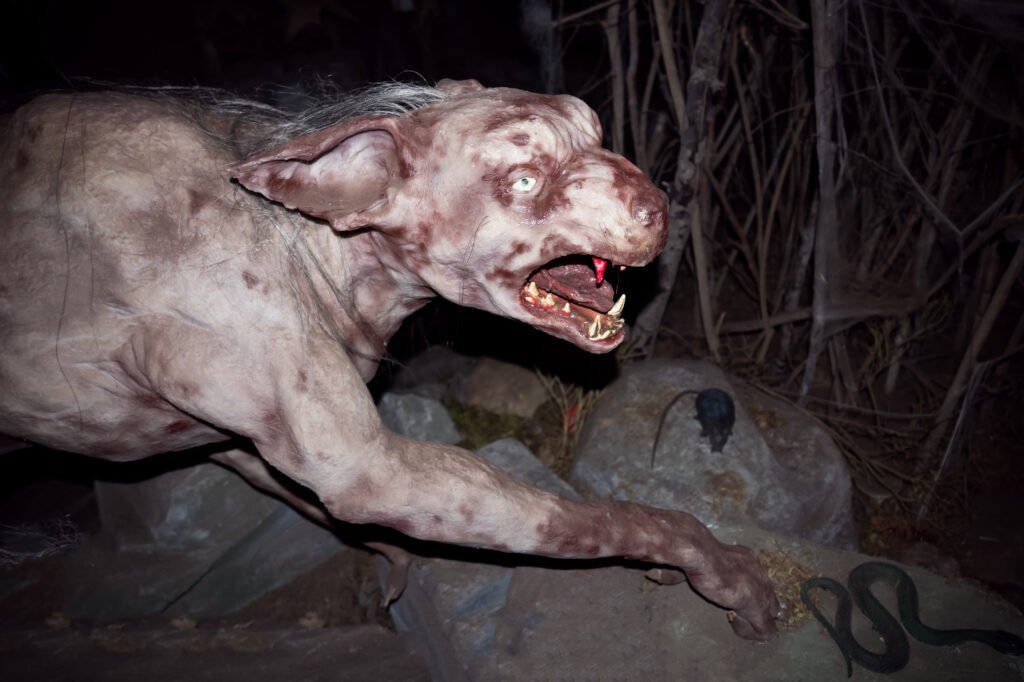
-Fangs, claws, large ears
-Mix of a kangaroo and a dog

A vampire beast of the 90s that sucks the blood from the livestock of Puerto Rico.
Background:
In 1975, the town of Moca, Puerto Rico, had a mysterious wave of livestock killings. Farmers discovered their animals drained of blood each with a small puncture wound. Locals named the unknown predator “El Vampiro de Moca” or the vampire of Moca. Authorities blamed wild dogs or cult activity, but locals found the wounds and the lack of blood similar to other instances including a 1995 series of attacks occurring in Canóvanas, where over 150 farm animals were found dead in the same condition. Around this time, Madelyne Tolentino claimed to see a strange, creature near her home—an account that helped develop the modern legend of the Chupacabra, or the “goat-sucker” that soon became part of Puerto Rican folklore.
Experts say:
Scientific investigations have sought to uncover the truth behind the Chupacabra, but none have been successful. The most notable was conducted by Benjamin Radford, author of Tracking the Chupacabra (2011). After a five year investigation he found the victims contained normal blood levels, contradicting claims that they had been drained concluding that many of the livestock deaths were likely caused by predators such as coyotes or raccoons, whose attacks can leave puncture wounds. Radford also observed that early eyewitness descriptions closely resembled the creature from the 1995 sci-fi film Species, suggesting that media influence played a major role in shaping the legend as it spread beyond Puerto Rico.
Today:
Today, reports of the Chupacabra are split in two main categories. The first is a reptilian creature with spines running down its back, said to inhabit the forests and mountains of Puerto Rico. The second depicts a more canine-like animal, often hairless, with fangs, glowing eyes, and gray, leathery skin, primarily reported in the southern United States and Mexico. The enduring belief in the Chupacabra stems from Latin American folklore, where tales of mysterious livestock deaths first sparked both fear and fascination. Though scientific evidence for the creature remains absent, the Chupacabra continues to endure as a symbol of mystery and cultural identity, blending myth, rumor, and modern imagination.
REFERENCES USED
Maria – stock.adobe.com
https://texnat.tamu.edu/files/2021/10/Diseases-Chupacabra-2017.pdf
https://en.wikipedia.org/wiki/Chupacabra